
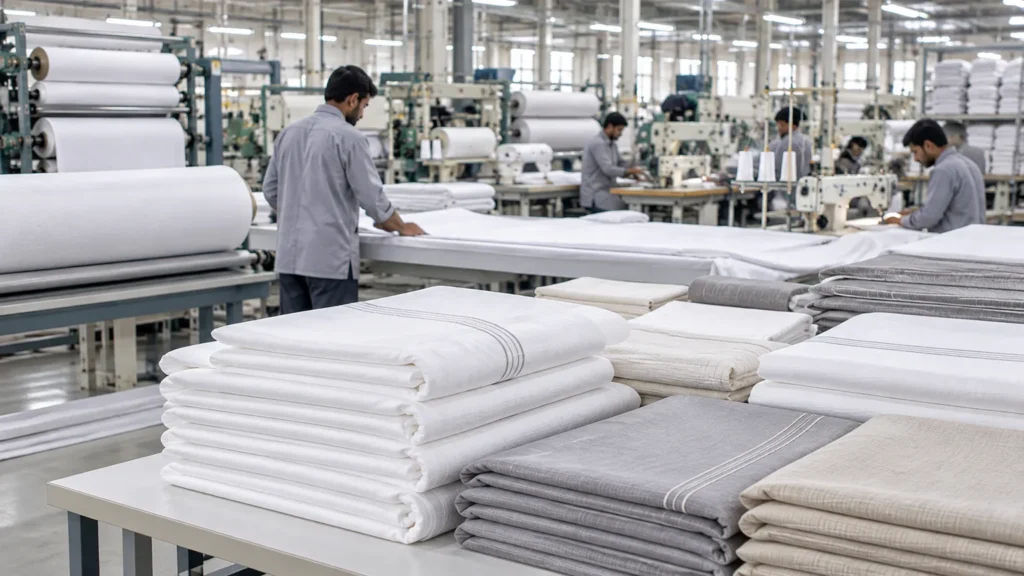
Finding bed linen manufacturers in Pakistan is relatively easy. Finding the right manufacturer for your product, quality level, order quantity, target market and delivery requirements is much harder.
Pakistan has an established export-oriented bedwear industry. The Pakistan Bureau of Statistics includes bedwear among Pakistan’s important textile export categories. International buyers source Pakistani bed linen for retail, wholesale, hospitality and institutional markets.
For buyers, however, the size of the industry does not remove the need for careful supplier selection.
A factory producing high-volume institutional bedding may not be suitable for a private-label retail collection. Another manufacturer may offer an attractive price but use a different fabric construction, finishing standard or packaging specification from what the buyer expected.
This guide explains how importers, wholesalers, retailers, hotel suppliers and private-label brands can evaluate bed linen manufacturers in Pakistan before placing an order.
For buyers evaluating Pakistan as a sourcing destination more broadly, see Why Source Textiles From Pakistan?.
Table of Contents
Why Source Bed Linen From Pakistan?
Pakistan has an established textile manufacturing base covering spinning, weaving, processing, dyeing, printing, stitching and made-up textile production.
International buyers can source a wide range of bed linen and textile products, including:
- Flat bed sheets
- Fitted sheets
- Duvet and quilt covers
- Pillowcases and pillow shams
- Complete bedding sets
- Hotel bed linen
- Institutional bedding
- Printed bedding
- Dyed bedding
- Private-label bedding
- Cotton and blended bedding
This manufacturing base gives buyers access to different factories depending on their product and order requirements.
But buyers should not assume that every manufacturer offers the same capabilities.
Machinery, fabric sourcing, processing, stitching, minimum order quantities, certifications, export experience and quality-control systems can vary between suppliers.
The objective should therefore be to find the right factory for the specific order, rather than simply finding a factory that produces bed linen.
How to Choose a Bed Linen Manufacturer in Pakistan
Start with your product specification.
Before requesting quotations, determine what type of manufacturer your program actually requires.
Important requirements include:
Product: Sheets, duvet covers, pillowcases, bedding sets or hospitality linen.
Fabric composition: 100% cotton, polyester-cotton or another required blend.
Construction: Percale, sateen or another weave.
Fabric specification: Thread count, yarn specification, weight and construction where applicable.
Dimensions: UK, European, US, Canadian or custom sizes.
Design: Solid dyed, printed, yarn dyed or another finish.
Branding: Brand labels, care labels, embroidery, inserts or other customization.
Packaging: Individual retail packaging, bedding sets, cartons or buyer-specific packaging.
Compliance: Required certifications, testing and social-compliance standards.
Quantity: Total order quantity and quantities by size, color and design.
The more accurately these requirements are defined, the more meaningful factory quotations become.
At Gallop, when we compare quotations for a buyer, we first try to normalize the important specifications.
If Factory A quotes a different fabric construction, packaging method or Incoterm from Factory B, simply comparing the two unit prices can lead to the wrong sourcing decision.
Compare like with like before comparing price.
Cotton vs Polycotton Bed Linen
Fabric composition is one of the first decisions when sourcing bedding.
100% cotton is widely used for residential, retail and hospitality bedding because buyers often prioritize comfort, breathability and natural fiber content.
Polycotton combines cotton and polyester and may be selected where buyers prioritize durability, easier care, reduced creasing or a particular price target.
Neither option is automatically correct for every buyer.
A premium retail collection can have completely different requirements from bedding designed for a high-turnover hospitality or institutional environment.
Buyers should therefore specify the required composition instead of requesting a quotation simply for:
“Cotton bed sheets.”
That description leaves too much room for suppliers to interpret the requirement differently.
Percale vs Sateen Bed Linen

Percale and sateen are two constructions commonly encountered when sourcing cotton bedding.
Percale generally provides a crisp feel and matte appearance. Buyers often select it when they want bedding with a clean, breathable character.
Sateen uses a different weave construction and generally produces a smoother feel with more surface luster.
Neither construction is automatically better.
The appropriate choice depends on the intended customer, desired hand feel, durability requirements, target price and positioning of the product.
For private-label programs, physical samples can be far more useful than choosing between percale and sateen from descriptions alone.
Understanding Bed Linen Thread Count
Thread count is frequently used to market bedding, but professional buyers should avoid treating it as the only measure of quality.
A larger number on a specification sheet does not automatically guarantee a better finished product.
Factors such as yarn quality, yarn count, fiber quality, weave construction, finishing and manufacturing consistency also affect how bedding feels and performs.
Instead of requesting only:
“400 thread count sheets”
buyers should understand the complete fabric specification being offered.
Ask the manufacturer what yarn and construction are being used, evaluate physical samples and ensure that bulk production is expected to match the approved quality.
This becomes especially important when comparing quotations from multiple manufacturers.
Bed Linen Sizes for Different Markets
Sizing is an easy place for an otherwise successful order to go wrong.
Terms such as Single, Double, Queen and King do not necessarily represent identical dimensions across countries, retailers or hospitality programs.
A buyer importing bedding into the UK may require different dimensions from a buyer supplying customers in the United States, Europe, Canada or the Middle East.
Fitted sheets introduce another important measurement: mattress depth.
For this reason, professional RFQs should not rely solely on size names.
Provide the finished dimensions in centimeters or inches for every SKU.
For example, specify the exact required dimensions for:
- Flat sheets
- Fitted sheets
- Duvet covers
- Pillowcases
This removes ambiguity before sampling and costing begin.
What Is the MOQ for Bed Linen in Pakistan?
There is no universal MOQ for bed linen manufacturers in Pakistan.
Minimum order quantities depend on factors such as:
- Manufacturer
- Fabric construction
- Custom weaving requirements
- Dyeing or printing
- Number of colors
- Number of designs
- Number of sizes
- Branding
- Packaging
- Total program volume
A manufacturer designed for very large export programs may not be economical for a small private-label launch.
Conversely, a manufacturer comfortable with smaller programs may not provide the same production capacity or economics required for very large orders.
This is why buyers should not select factories based on factory size alone.
Gallop works on a flexible MOQ sourcing basis. We can match buyer requirements with manufacturers suited to different order sizes, from smaller programs to large-volume production.
You can see the overall sourcing process on How Gallop Works.
How Much Does Bed Linen From Pakistan Cost?
There is no meaningful single price for “Pakistani bed linen.”
The cost depends on the specification.
Major pricing factors can include:
- Cotton and yarn prices
- Fabric composition
- Yarn count
- Fabric construction
- Thread count
- Fabric weight
- Dyeing or printing
- Finishing
- Product dimensions
- Stitching requirements
- Order quantity
- Number of colors and designs
- Labels and branding
- Retail packaging
- Testing and compliance
- Incoterm
This is why the lowest quotation is not necessarily the lowest-cost sourcing option.
If one supplier’s quotation is substantially cheaper, determine what is different before assuming it represents better value.
For example, differences in fabric construction, finished dimensions, packaging or quality requirements can produce different prices for products that initially appear identical.
Private Label Bed Linen Manufacturing in Pakistan
Pakistan can support private-label bedding programs for retailers, wholesalers and brands.
Depending on the selected manufacturer and program requirements, customization can include:
- Buyer brand labels
- Care and composition labels
- Custom colors
- Printed designs
- Embroidery
- Custom dimensions
- Packaging
- Inserts
- Barcodes
- Carton markings
These details should be finalized during product development rather than after bulk production has started.
Artwork, label dimensions, packaging specifications, barcode requirements and other branding elements should be approved before production.
Sampling Before Bulk Production
Sampling is one of the most important stages of a bedding order.
A sample allows the buyer to evaluate the physical product rather than relying entirely on quotations, photographs and technical descriptions.
Depending on the program, buyers should evaluate:
- Fabric feel
- Fabric appearance
- Color
- Print quality
- Dimensions
- Stitching
- Construction
- Labels
- Packaging
- Overall workmanship
For customized and repeat programs, the approved sample can also provide an important reference when evaluating bulk production.
If a sample has unresolved problems, those issues should be addressed before bulk production begins.
Approving an imperfect sample and hoping the factory will correct everything during production creates unnecessary sourcing risk.
How to Verify a Bed Linen Manufacturer in Pakistan
A professional website, product catalog or competitive quotation is not enough to verify a supplier.
Before committing to a significant order, buyers should understand who will actually manufacture their products.
Depending on the size and risk of the order, supplier verification can include checking:
- Factory location
- Manufacturing capabilities
- Machinery
- Production setup
- Product specialization
- Export experience
- Production capacity
- Quality-control procedures
- Relevant certifications
- Social-compliance requirements
- Ability to produce the required specification
- Sampling performance
Buyers should also understand whether they are dealing with the actual manufacturer or a trading company.
Neither business model is automatically unsuitable, but the buyer should know who is manufacturing the product and who is accountable for quality and delivery.
This is one of the reasons working with a sourcing partner on the ground in Pakistan can be useful for overseas buyers.
Certifications and Compliance
Certification requirements depend on the product, selected manufacturer, buyer and destination market.
Large retailers, hospitality groups and independent wholesalers can have very different compliance requirements.
Depending on the program, buyers may encounter requirements involving standards or compliance frameworks such as:
- OEKO-TEX
- GOTS
- SMETA/Sedex
- BSCI
- Buyer-specific social or technical compliance programs
Certification should never be assumed simply because a supplier mentions it during an initial discussion.
If a certification is mandatory, confirm that the specific manufacturing facility and relevant certification scope meet your requirements and request current supporting documentation.
Gallop can source according to buyer requirements, but certification availability varies by manufacturer and product program.
For more information about how Gallop approaches inspection and product quality, see Quality Control.
Quality Control for Bed Linen
Quality control should begin before finished cartons are waiting for shipment.
The required product standard should first be established through the specification and sampling process.
Depending on the product, bedding inspection can include:
- Fabric appearance
- Color consistency
- Printing
- Stains or contamination
- Stitching
- Seams
- Finished dimensions
- Fitted-sheet elastic and construction
- Labels
- Packaging
- Assortments
- Carton markings
- Workmanship
- Quantity
Testing requirements may also include shrinkage, colorfastness, fiber composition or other performance criteria depending on the buyer’s specification.
A final pre-shipment inspection can then assess finished goods against the agreed requirements before shipment.
Gallop can coordinate quality control and AQL 2.5 inspection according to the agreed inspection requirements.
The purpose of inspection is not simply to produce a report. It is to determine whether the finished order matches what the buyer actually approved before the goods leave Pakistan.
Common Mistakes When Sourcing Bed Linen
One of the most common sourcing mistakes is sending factories an inquiry such as:
“Please quote your best price for 10,000 cotton bedsheets.”
There is not enough information in that request to produce genuinely comparable quotations.
Another common mistake is selecting a supplier primarily on unit price before confirming fabric construction and finished quality.
Buyers can also create problems by:
- Relying only on thread count
- Assuming bedding size names are universal
- Skipping physical samples
- Leaving packaging decisions until late in production
- Failing to define testing requirements
- Assuming certifications without verification
- Comparing quotations based on different Incoterms
- Leaving quality expectations unclear until final inspection
A detailed RFQ at the beginning can prevent many of these issues.
What to Include in a Bed Linen RFQ
Before contacting bed linen manufacturers in Pakistan, prepare as much of the following information as possible:
- Product type
- Total quantity
- Quantity by size, color and design
- Finished dimensions
- Fabric composition
- Required weave or construction
- Thread count or other fabric specification
- Color or print requirements
- Stitching and construction details
- Branding and labels
- Packaging requirements
- Required certifications or testing
- Destination country and port/city
- Required Incoterm
- Target delivery date
- Reference images, physical samples or specification sheets
Providing this information allows manufacturers to prepare more accurate quotations and makes supplier comparison much easier.
Don’t have every specification finalized yet?
That’s fine.
Start with your product, approximate quantity, intended market, required quality level and destination. The remaining specification can be developed before factories are approached for final quotations.
Direct Manufacturer or Sourcing Partner?
Some experienced importers prefer working directly with a manufacturer.
That approach can work well when the buyer already understands the Pakistani manufacturing market, has identified an appropriate factory and has resources available to manage development, production, quality and shipment coordination.
Other buyers prefer using a sourcing partner.
The value of a sourcing partner should extend beyond providing a supplier’s telephone number.
A sourcing partner can compare manufacturing options against the actual product specification, coordinate samples and quotations, follow production, arrange quality checks and help manage the order through shipment.
For international buyers, having someone locally accountable during the sourcing and production process can also reduce the difficulty of managing factories remotely.
The appropriate model depends on the buyer’s own sourcing capabilities and requirements.
Buyers new to the process may also find our guide on how to import textiles from Pakistan useful for understanding the broader sourcing and import process.
How Gallop Sources Bed Linen in Pakistan
Gallop Sourcing is a textile sourcing partner, not a single bed linen factory.
That distinction is important.
Instead of requiring every buyer to fit the capabilities of one manufacturer, Gallop can evaluate manufacturing options across Pakistan according to the requirements of the order.
The process typically begins with the buyer’s product specification, quantity, quality requirements and destination.
From there, Gallop can support:
Factory selection → quotation comparison → sampling → production monitoring → quality inspection → shipping documentation and delivery coordination.
When comparing potential manufacturers, the objective is not simply to identify the factory offering the lowest quoted unit price.
The objective is to identify a manufacturing setup capable of producing the required product at the required quality, quantity, price and delivery schedule.
One sourcing partner. Multiple manufacturing options.
Looking for Bed Linen Manufacturers in Pakistan?
If you are sourcing bed sheets, duvet covers, pillowcases, hotel bedding or private-label bed linen from Pakistan, send Gallop your requirements.
Include your product specification, quantity, target market, destination and any reference images, tech packs or existing samples available.
If your specification is not complete yet, send the information you already have and we can help identify what needs to be clarified before requesting factory quotations.
Gallop can support the sourcing process from RFQ and factory selection through sampling, production monitoring, quality control and shipment coordination.