
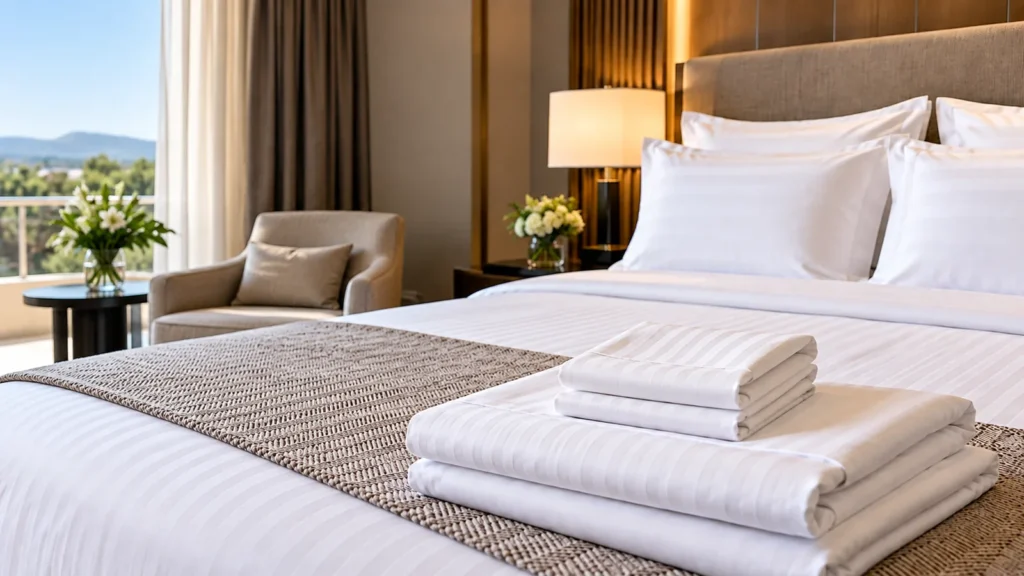
Hotel bed linen has to do something ordinary residential bedding does not: deliver a consistent guest experience while standing up to repeated commercial use and laundering.
A sheet can feel excellent when it is new and still be the wrong choice for a hotel if it shrinks excessively, loses its appearance after repeated washing, takes too long to process, or becomes difficult to replace consistently.
For hotels, resorts, serviced apartments, hospitality distributors and procurement companies, buying bed linen therefore requires more than choosing a thread count and asking for the lowest price.
Fabric composition, weave, construction, finished dimensions, mattress depth, laundry requirements, shrinkage, stitching, packaging and repeat-order consistency all matter.
This guide explains what hospitality buyers should specify when sourcing hotel bed linen, how to compare different options and what to check before placing a bulk order.
Table of Contents
What Is Hotel Bed Linen?
Hotel bed linen is bedding designed or specified for hospitality and other commercial accommodation environments.
Depending on the property, a hotel bedding program can include:
- Flat sheets
- Fitted sheets
- Duvet covers
- Pillowcases
- Pillow protectors
- Mattress protectors
- Duvet protectors
- Decorative pillowcases or shams
- Bed runners and other top-of-bed products
The exact program varies by property.
A luxury resort, airport hotel, serviced apartment operator and budget hotel chain can have completely different requirements even when all four are purchasing white bedding.
That is why professional sourcing should begin with the property’s operational requirements rather than with a generic request for “hotel sheets.”
What Makes Hotel Bed Linen Different?
Hotel bedding has to balance guest comfort with commercial performance.
Guests notice softness, cleanliness, appearance and how the bed feels.
Hotel operators also have to consider:
- Repeated laundering
- Drying and finishing time
- Shrinkage
- Stain management
- Creasing
- Labour requirements
- Product lifespan
- Replacement availability
- Housekeeping efficiency
- Cost per use
A more expensive sheet that performs consistently over repeated laundry cycles may ultimately offer better value than a cheaper product that requires frequent replacement.
Commercial hospitality bedding is therefore developed around both guest experience and operational performance. Standard Textile’s hospitality sheeting, for example, demonstrates how commercial constructions can combine cotton with other fibres to balance comfort and service life.
Hotel buyers should compare the complete specification and expected performance, not simply the initial unit price.
What Products Should a Hotel Bedding Program Include?
A hotel bedding program normally starts with sheets, duvet covers and pillowcases, but the exact assortment should reflect how the property operates.
Flat Sheets
Flat sheets are widely used in hospitality and can simplify stock management and laundering.
They may be used as bottom sheets, top sheets or as part of a layered bedding system depending on the property.
Fitted Sheets
Fitted sheets provide a defined fit around the mattress but require accurate dimensions.
Mattress depth is particularly important.
A fitted sheet designed for a standard mattress may not fit correctly if the hotel uses a deeper mattress or topper.
Duvet Covers
Duvet covers should be specified by finished dimensions, construction, closure and fabric quality.
Hotels should also consider how easily housekeeping teams can change them.
Pillowcases
Specify the exact finished size and construction.
Common options include bag-style and envelope-style pillowcases, but the appropriate choice depends on the property and market.
Mattress and Pillow Protection
Protectors can form an important part of the bedding system even though they are not always considered decorative linen.
They should be specified separately according to the required protection, washability and construction.
100% Cotton vs Polycotton Hotel Bed Linen
This is one of the most important decisions in a hotel bedding specification.
100% Cotton
Cotton is commonly selected where a property prioritises:
- Natural fibre content
- Breathability
- Guest comfort
- Premium positioning
- A particular hand feel
However, “100% cotton” alone is not a complete quality specification.
Fibre quality, yarn, weave, construction and finishing can substantially affect the finished product.
Polycotton
Cotton-polyester blends are also widely used in commercial hospitality programs.
Depending on the construction, blends may provide advantages relating to:
- Durability
- Crease management
- Drying
- Ease of processing
- Operational cost
This is why polycotton should not automatically be viewed as an inferior alternative to 100% cotton.
Which Should a Hotel Choose?
There is no universal answer.
A luxury boutique hotel may prioritise a different hand feel from a large property processing thousands of pieces of linen every week.
The decision should consider:
Guest expectation + laundry operation + required lifespan + budget.
Whenever possible, compare physical samples rather than making the decision from specifications alone.
Percale vs Sateen for Hotels
Percale and sateen can both be used for hotel bed linen, but they provide different characteristics.
Percale
Percale typically has a crisp, clean feel and a more matte appearance.
It can work well for hospitality buyers seeking the familiar fresh hotel-bed feel.
Sateen
Sateen generally provides a smoother hand and more visible lustre.
It can suit properties seeking a softer or more luxurious presentation.

The difference is not simply about thread count. Fibre, yarn and weave construction all influence the finished fabric.
For a useful overview of the differences, see the Frette Fabric Guide.
For a bulk hotel program, the best way to decide is normally to compare physical samples under the property’s actual performance requirements, rather than choosing from descriptions alone.
What Thread Count Is Best for Hotel Bed Linen?
Thread count is one of the most misunderstood hotel bedding specifications.
It measures the number of threads within a defined area of fabric, but it should not be treated as a standalone quality score.
Two fabrics advertised with similar thread counts can perform very differently because of differences in:
- Fibre quality
- Yarn quality
- Yarn count
- Weave
- Finishing
- Construction
- Manufacturing consistency
Should Hotels Buy the Highest Thread Count Possible?
Not necessarily.
A hotel needs bedding appropriate for its positioning and its laundry operation.
A very high thread count does not automatically mean that a product will be more suitable for commercial hospitality use.
Instead of asking:
What is the highest thread count you sell?
A better procurement question is:
What construction provides the guest feel we require while meeting our laundering, durability and operational requirements?
Thread count should be considered as part of the complete hotel bed linen specification.
Hotel Bed Linen Sizes and Mattress Depth
Sizing is an easy place to make an expensive mistake.
Terms such as:
- Single
- Double
- Queen
- King
do not guarantee identical dimensions across every country, hotel or supplier.
Professional hotel RFQs should therefore specify finished dimensions, preferably in centimetres or inches.
For fitted sheets, provide:
Mattress width × mattress length × mattress depth
If mattress toppers are used, account for them too.
The same principle applies to:
- Flat sheets
- Duvet covers
- Pillowcases
- Mattress protectors
- Duvet protectors
Do not rely on “King Size” alone.
An extra few centimetres can determine whether a fitted sheet performs correctly in daily hotel operations.
Commercial Laundry and Durability
A hotel bed linen sample should not only look good when it comes out of the package.
Hotels need to understand what happens after repeated laundering.

Shrinkage
Excessive dimensional change can create fitting problems after laundering.
Finished dimensions and acceptable tolerances should therefore be agreed before bulk production.
Colour and Whiteness
White hotel bedding needs to maintain an acceptable appearance through the property’s laundry process.
For coloured or custom bedding, colourfastness becomes particularly important.
Pilling and Surface Appearance
The fabric should maintain an appropriate surface and appearance through expected use and care.
Seam and Stitching Performance
High-quality fabric means little if seams, hems or closures fail prematurely.
Laundry Compatibility
Before ordering, the supplier should understand whether the linen will be processed through:
- On-site hotel laundry
- Industrial or commercial laundry
- Third-party laundry provider
The hotel’s laundering process should form part of the sourcing specification rather than becoming an afterthought.
White vs Coloured Hotel Bedding
White remains common in hospitality for practical and aesthetic reasons.
It creates a familiar, clean presentation and can simplify coordination across rooms and replenishment programs.
Hotels are not, however, restricted to plain white bedding.
Depending on the property concept, buyers may specify:
- White
- Dyed colours
- Woven stripes
- Jacquard patterns
- Embroidery
- Piping
- Contrast details
- Custom designs
The more customised the design becomes, the more important repeat-order consistency becomes.
A hotel should consider whether the same shade, fabric and construction can be reproduced when replenishment is required months or years later.
Hotel Bed Linen Specification Checklist
Before requesting quotations, define as much of the specification as possible.
| Specification | What the Buyer Should Define |
|---|---|
| Product | Flat sheet, fitted sheet, duvet cover, pillowcase, protector |
| Composition | 100% cotton, cotton/polyester blend or other |
| Weave | Percale, sateen or specified construction |
| Fabric specification | Thread count and yarn/construction where required |
| Finished size | Exact dimensions in cm or inches |
| Mattress | Width × length × depth |
| Colour | White, dyed or custom |
| Design | Plain, stripe, jacquard, embroidery, etc. |
| Construction | Hems, closures and stitching details |
| Shrinkage | Required tolerance/test method |
| Branding | Woven label, printed label, embroidery, etc. |
| Care label | Buyer and destination-market requirements |
| Packaging | Bulk, individual or custom |
| Quantity | Total quantity and quantity by SKU |
| Compliance | Required testing or certifications |
| Laundry | Expected commercial laundry conditions |
| Destination | Country, city or port |
| Delivery | Required timeline and Incoterm |
A manufacturer can quote much more accurately against this information than against:
“Please quote 5,000 hotel bedsheets.”
Custom Hotel Bedding and Branding
Hotel bed linen can be customised according to the project and manufacturer’s capabilities.
Options can include:
- Custom dimensions
- Woven hotel labels
- Printed care labels
- Embroidered logos
- Monograms
- Woven stripes
- Coloured piping
- Custom packaging
- Buyer-specific carton markings
High-end hospitality programs can go considerably further with customised fabrics, colours, designs and monograms. Frette’s hospitality operation is one example of how extensive hospitality customisation can become.
Customization should be finalised before bulk production, with artwork, dimensions, placement and colours approved during sampling.
MOQ and Bulk Ordering
There is no universal MOQ for hotel bed linen.
Minimum quantities can depend on:
- Fabric
- Construction
- Custom weaving
- Colour
- Sizes
- Number of SKUs
- Embroidery
- Labels
- Packaging
- Factory
- Overall program volume
A standard white bedding program may provide greater production flexibility than a completely custom woven hotel collection.
At Gallop Sourcing, we can work with different order quantities by matching the requirement with an appropriate manufacturing setup rather than applying one fixed MOQ across every product.
The important point is to communicate the expected quantity by product, size and specification when requesting a quotation.
Sampling Before Bulk Production
For a significant hospitality program, physical samples should be evaluated before bulk production.
Check:
- Fabric hand feel
- Colour or whiteness
- Dimensions
- Stitching
- Hems
- Closures
- Labels
- Embroidery or branding
- Overall workmanship
- Packaging
For hotel bedding, it can also be valuable to evaluate the sample after laundering under relevant conditions.
A sample that looks excellent before its first wash does not tell the whole story.
Once approved, the specification and sample can provide references for bulk production.
Quality Control for Hotel Bed Linen
Quality control should start before the final cartons are packed.
For hotel bed linen, checks can include:
- Fabric appearance
- Colour consistency
- Stains and contamination
- Weaving defects
- Stitching
- Seam quality
- Finished dimensions
- Fitted-sheet construction
- Closures
- Labels
- Branding
- Packaging
- Quantity and assortments
- Carton markings
- Overall workmanship
Where required, laboratory testing can address characteristics such as fibre composition, shrinkage, colourfastness and other buyer-defined performance requirements.
At Gallop Sourcing, quality control can be integrated throughout the sourcing process, from sample review and production monitoring to pre-shipment inspection.
Learn more about our quality control and inspection process.
How to Compare Hotel Bed Linen Suppliers
Do not compare suppliers using unit price alone.
First make sure every supplier is quoting the same product and specification.
Compare:
- Fabric composition
- Fabric construction
- Finished dimensions
- Thread and yarn specification where relevant
- Shrinkage requirements
- Stitching and construction
- Labels and branding
- Packaging
- Testing
- Certifications
- MOQ
- Lead time
- Inspection arrangements
- Incoterm
- Replenishment capability
A quotation that is 10% cheaper is not necessarily cheaper if it represents a materially different product.
This is particularly important in international sourcing because different factories may interpret an incomplete RFQ differently.
For more information about evaluating bedding manufacturers, read our Bed Linen Manufacturers in Pakistan: A Buyer’s Sourcing Guide.
Common Hotel Bedding Sourcing Mistakes
Buying on Thread Count Alone
Thread count is one specification, not a complete measure of hotel bedding quality.
Using Size Names Instead of Dimensions
“King” is not a sufficient manufacturing specification. Provide exact finished dimensions.
Ignoring Mattress Depth
This is particularly dangerous when ordering fitted sheets.
Selecting the Cheapest Quote
A lower quotation may reflect different fabric, construction, dimensions, packaging or quality expectations.
Skipping Wash Evaluation
Hotel bedding exists in a repeated laundry cycle. Evaluate samples accordingly.
Approving Samples Too Quickly
Resolve problems during product development rather than expecting them to disappear during bulk production.
Forgetting About Replenishment
Hotels continually replace linen. Consider whether future orders can reproduce the approved quality consistently.
Leaving Laundry Requirements Until the End
Commercial laundry performance should influence the product specification from the beginning.
What to Include in a Hotel Bed Linen RFQ
When approaching a supplier or sourcing partner, provide:
- Property or project type
- Number of rooms or required quantities
- Product list
- Quantity by product and size
- Exact finished dimensions
- Mattress dimensions and depth
- Fabric composition
- Required weave or construction
- Thread or yarn specification, if defined
- Colour and design
- Branding requirements
- Packaging requirements
- Required certifications or testing
- Commercial laundry requirements
- Destination
- Required delivery date
- Incoterm, if known
- Reference images or existing samples
Don’t have everything finalised yet?
Start with the property type, products, approximate quantity, target quality and destination.
The complete specification can then be developed before final factory quotations are compared.
How Gallop Sourcing Can Help
Gallop Sourcing is not limited to one hotel bed linen factory.
We work across a network of textile manufacturers in Pakistan and match manufacturing options to the buyer’s actual requirement.
That distinction matters in hospitality procurement.
A manufacturer suited to a large-volume standard white bedding program may not be the right factory for a smaller luxury custom collection.
Depending on the requirement, Gallop can support:
Requirement review → factory matching → quotation comparison → sample development → production monitoring → quality control → shipment coordination
The objective is to provide international buyers with one sourcing partner and access to multiple manufacturing options.
You can see our complete process on How Gallop Sourcing Works.
Buyers sourcing internationally can also read our step-by-step guide to importing textiles from Pakistan.
Frequently Asked Questions About Hotel Bed Linen
What is the best material for hotel bed linen?
There is no single best material for every hotel. 100% cotton can be appropriate where natural fibre content and a particular guest feel are priorities, while cotton-polyester blends can provide operational advantages depending on their construction. The correct choice depends on the property’s positioning, laundry operation and performance requirements.
What thread count is best for hotels?
Hotels should not select bedding on thread count alone. Fibre quality, yarn, weave, finishing, durability and laundering requirements also influence performance. Buyers should choose a complete fabric specification appropriate for the property rather than simply purchasing the highest available thread count.
Is percale or sateen better for hotel bedding?
Percale generally offers a crisp, matte feel, while sateen tends to feel smoother and have more lustre. Neither is universally better. The choice should reflect the required guest experience, climate, laundry operation and overall product specification.
Should hotels use cotton or polycotton sheets?
Both are used in hospitality. Cotton may be preferred for natural feel and positioning, while cotton-polyester constructions can provide operational benefits depending on the specification. Physical samples and laundry evaluation can help buyers compare the options.
Can hotel bed linen be custom branded?
Yes. Depending on the manufacturer and order, customisation can include woven labels, care labels, embroidery, monograms, custom dimensions, woven patterns, piping and packaging.
What should I send when requesting a hotel bedding quotation?
At minimum, provide the products, quantities, exact sizes, fabric preference, quality level, destination and required delivery date. For more accurate quotations, provide the complete specification wherever possible.
Can hotels order custom sizes?
Yes. Custom dimensions can be manufactured subject to the manufacturer’s capabilities and order requirements. Exact finished dimensions should be agreed before sampling and production.
How should hotel bed linen be inspected before shipment?
Inspection should compare bulk production against the approved specifications and samples. Checks can include fabric appearance, dimensions, stitching, construction, labels, branding, packaging, quantities and overall workmanship, with relevant laboratory testing added where required.
Source Hotel Bed Linen with Gallop Sourcing
If you are sourcing hotel bed linen for a hotel, resort, serviced apartment, hospitality distributor or procurement program, send us your requirement.
For the fastest assessment, include:
Product + dimensions + fabric/specification + quantity + destination + required delivery date
If your specification is not complete yet, send what you already know.
Gallop Sourcing can help structure the requirement, identify suitable manufacturing options, coordinate samples, monitor production and inspect the finished order before shipment.
Send Your Hotel Bed Linen Requirement